
Modern Drywall Texture Types That Elevate Any Room
Drywall texture has moved past the thick, dated finishes many homeowners grew up with. Modern drywall texture types favor subtle, refined surfaces over heavy popcorn or deep knockdown patterns. These finishes still hide seams and minor imperfections, but they do it with a cleaner, more intentional look.
Choosing the right texture affects how light moves across a room, how easy the wall is to clean, and how much a repaint or repair will cost later. This guide walks through the drywall textures that define modern interiors, where each one works best, and how to decide between them.
What Makes a Drywall Texture “Modern”
Older texture styles like heavy popcorn or aggressive knockdown were originally chosen for practical reasons. They hid uneven drywall taping and reduced the number of coats needed to finish a wall. The tradeoff was a busy, dated surface that collected dust and was hard to patch cleanly.
Modern texture types reverse that priority. They lean toward flatter, more even surfaces with just enough variation to add depth without drawing attention to itself. Many of today’s most requested finishes are actually closer to a skilled smooth finish than a true heavy texture. The goal is a wall that reads as intentional, not one that is simply covering a mistake.
Popular Modern Drywall Texture Types
Skip Trowel Texture
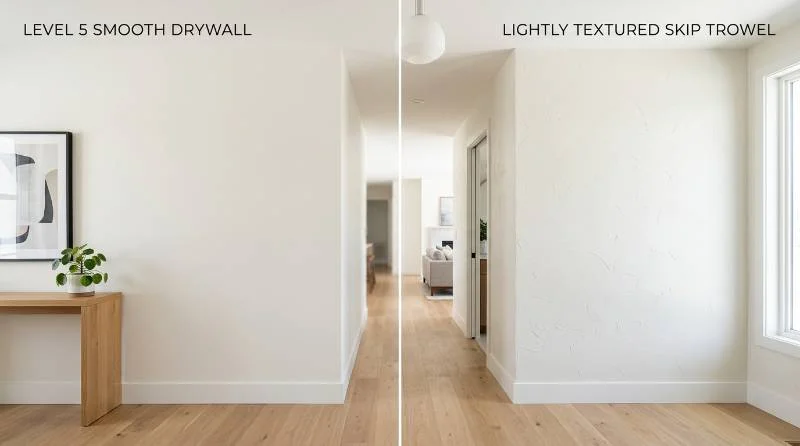
Skip trowel creates a soft, irregular pattern by dragging a trowel loaded with thinned joint compound across the wall. The trowel skips over the surface, leaving light ridges and flat spots rather than a uniform pattern. It reads as handcrafted rather than sprayed on.
This texture works particularly well in Mediterranean, Southwestern, and modern farmhouse interiors. It hides minor drywall flaws without looking heavy, and it takes paint well because the surface variation is shallow. Skip trowel does require a skilled hand, since an inconsistent trowel technique becomes obvious once the wall is painted.
Venetian Plaster Style Finish
True Venetian plaster is a lime-based material, but many modern homes achieve a similar look using tinted joint compound applied in thin layers over drywall. The result is a subtly mottled, almost polished surface with soft depth instead of a flat, uniform color.
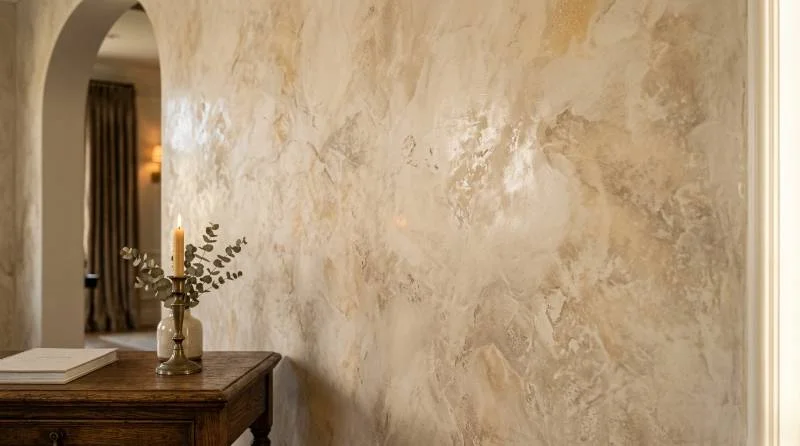
This finish suits accent walls, powder rooms, and spaces where a homeowner wants texture that reads as luxury rather than practicality. It costs more in labor than a basic texture because it typically requires multiple thin coats and burnishing between layers.
Fine Orange Peel
Orange peel gets its name from the light, pebbled surface that resembles citrus skin. The modern version of this texture uses a finer spray pattern than older orange peel finishes, producing a subtler surface that is easy to overlook until you touch it.
Fine orange peel remains one of the most common textures in new construction because it is fast to apply and forgiving of minor taping imperfections. It also patches more easily than heavier textures, which matters if you plan to hang art, mount shelving, or run new wiring later.
Sand Swirl
Sand swirl mixes fine sand into the joint compound, then applies it in a swirled, fan-shaped pattern using a trowel or brush. The sand adds a light, gritty texture that catches ambient light differently than a smooth wall.
This finish works well on ceilings and larger wall sections where a fully smooth surface would show every dip and bow. It is less common as an accent wall choice since the pattern reads best across a large, unbroken surface.
Level 5 Smooth Finish
A Level 5 finish is technically the absence of texture. Drywall installers skim coat the entire surface with a thin layer of joint compound and sand it smooth, eliminating any visible seams, fastener heads, or texture variation. It is the finish most associated with high-end modern and minimalist interiors.
Level 5 costs more than any textured option because it demands precise taping and multiple skim coats before painting. It also shows every flaw under raking light from windows or accent lighting, so the drywall installation underneath has to be nearly flawless.
Limewash Textured Walls
Limewash is technically a paint treatment rather than a joint compound texture, but it has become closely associated with modern drywall finishing because of how it interacts with a slightly textured base coat. Applied over a light skip trowel or hand-troweled surface, limewash creates soft color variation and a chalky, matte depth.
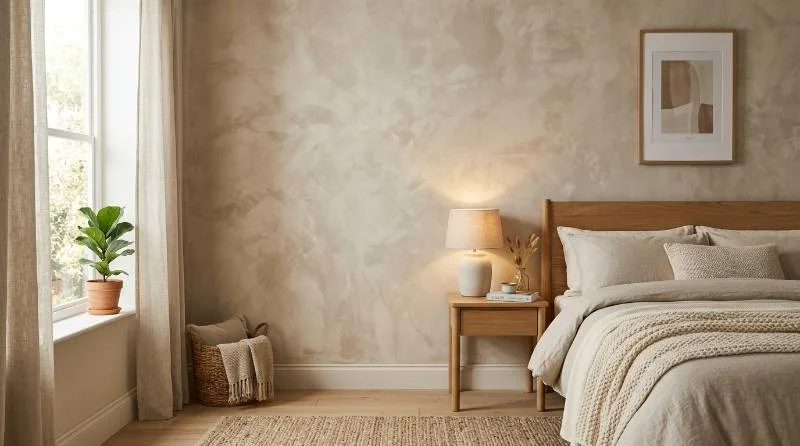
This combination suits bedrooms, dining rooms, and any space where a homeowner wants warmth without pattern. It requires a textured base underneath to look authentic, since limewash over a perfectly flat wall reads as flat paint rather than a finish.
Modern Drywall Textures for Ceilings vs Walls
Ceilings and walls face different practical demands, and the right texture for one is not always right for the other. Ceilings need to hide seams from an angle that catches direct light from windows and fixtures, which is why sand swirl and fine orange peel remain common choices overhead.
Walls sit at eye level and get touched, bumped, and repainted more often, so smoother options like Level 5 or fine skip trowel tend to hold up better over time. An accent wall can carry a bolder texture like Venetian plaster since it is a smaller, more controlled surface than a full ceiling.
How to Choose the Right Texture for Your Home
Start with how the room is lit. Rooms with large windows or strong overhead lighting will show every ridge and dip in a texture, so a heavier pattern can look busy under raking light. Rooms with softer, indirect lighting can carry more texture without looking overdone.
Next, consider how the space is used. High-traffic hallways and kids’ rooms benefit from a finish that patches easily, which rules out complex layered textures like Venetian plaster. Formal living rooms and primary bedrooms can support a finish that takes more effort to repair since they see less daily wear.
Finally, match the texture to the rest of the home’s finishes. A house with matte black hardware, wide plank flooring, and minimal trim generally reads better with a smoother, quieter wall texture. A home with more traditional millwork and warmer finishes can carry a hand-troweled or swirled texture without feeling out of place.
DIY Versus Hiring a Professional
Fine orange peel and basic skip trowel are the most DIY-friendly modern textures, since minor inconsistencies blend into the overall pattern. A hopper gun and some practice on scrap drywall are usually enough to get a workable result on a small room.
Level 5 finishes and Venetian plaster style walls are much harder to execute well without experience. Both rely on precise, even application, and mistakes are difficult to hide once the wall is painted. For these finishes, hiring a licensed drywall finisher or plasterer almost always produces a better result than attempting it as a first project.
Cost Considerations for Modern Drywall Textures
Texture cost depends on material, labor time, and the number of coats required. Fine orange peel and sand swirl are among the least expensive options since they apply in a single pass with a sprayer. Skip trowel costs more due to the hand-applied technique and slower pace.
Level 5 smooth finishes and Venetian plaster style walls sit at the top of the price range. Both require multiple thin coats, careful sanding between layers, and a finisher skilled enough to keep the surface consistent across an entire wall or ceiling.
Maintenance and Repair of Modern Drywall Textures
Smoother textures are generally easier to patch than heavily patterned ones, since there is less surface variation to match. A small hole in a fine orange peel or skip trowel wall can usually be repaired and blended without a visible seam.
Layered finishes like Venetian plaster and limewash are harder to repair invisibly, since matching the exact depth and tone of multiple thin coats takes practice. For these finishes, it often makes sense to keep a small amount of the original material on hand for future touch-ups.