

Best Solo Stove Accessories for Every Fire Pit Owner
Owning a Solo Stove fire pit and owning a fire pit you actually use often are two different things. The stove itself handles the smokeless burn well on its own. What separates a casual owner from someone who gets years of trouble-free use out of it is the accessories around it: something to lift it off the ground, something to protect the deck underneath, and a way to cook on it if that matters to you.
This guide breaks down which Solo Stove accessories genuinely earn their price, which ones solve a real problem for a specific group of owners, and which ones you can skip without losing anything. It also covers how accessory needs change depending on which Solo Stove size you own, since a Ranger owner and a Yukon owner are not shopping for the same thing.
Why Solo Stove Accessories Matter More Than They Look
A Solo Stove fire pit works by pulling air through the double-wall design to burn wood more completely and produce less smoke. That design also means the bottom of the unit gets extremely hot during use, and it sits directly on whatever surface is underneath it. Without a stand or a heat-resistant pad, a wood or composite deck can scorch, and even concrete can discolor over repeated use.
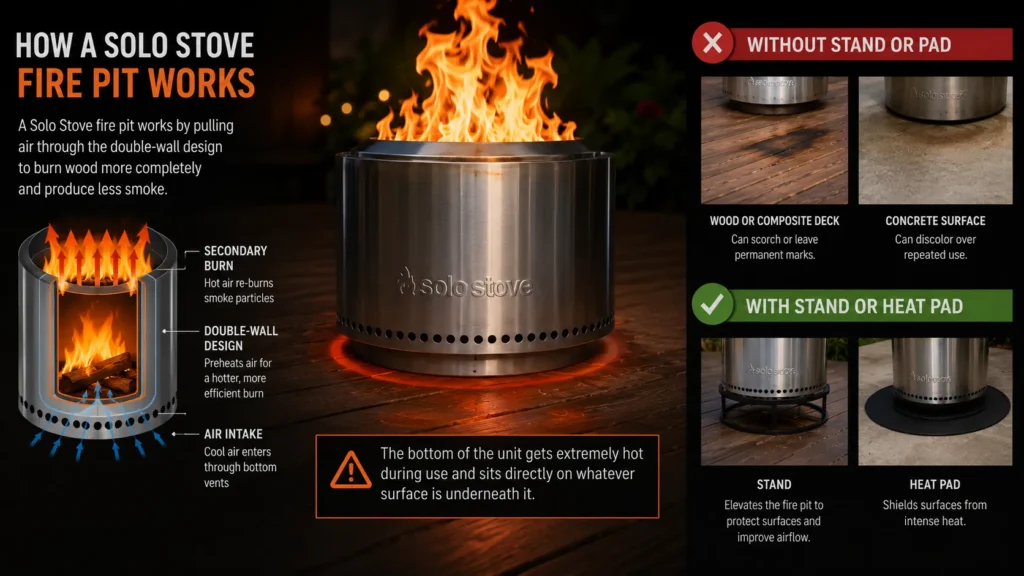
Accessories also solve problems that show up only after a few uses, not on day one. Ash builds up faster than most first-time owners expect, wind changes how the fire burns without a shield, and the exterior finish will pit or rust if left uncovered through a wet season. None of this is obvious from the product page. It becomes obvious the first time you deal with it.
Essential Solo Stove Accessories for Every Owner
These are the accessories worth buying regardless of which model you own or how often you use it.
1. A Stand or Heat Deflector
This is the one accessory that should not be treated as optional. A Solo Stove stand lifts the fire pit a few inches off the ground, which protects decks, grass, and stone patios from heat damage. Solo Stove sells its own stand for most models, and it is worth the cost specifically because it is sized to match the base exactly. Universal heat-resistant pads work too, but they need to be rated for direct, sustained high heat rather than general grill mats, which are not built for the same temperature range. Even with a stand, ash and soot residue eventually builds up on the deck underneath, and a dedicated outdoor cleaner handles that kind of buildup better than soap and water.
2. An Ash Pan or Ash Scoop
Ash from a wood fire is fine and gets into everything if you try to scoop it with a shovel meant for coals. A dedicated ash pan that sits under or beside the unit, paired with a small metal scoop, cuts cleanup time down significantly. Skipping this usually means ash ends up tracked across the patio or dumped in a way that damages grass underneath.
3. A Fire Pit Cover
Solo Stove units are stainless steel, which resists rust better than plain steel but is not immune to it, especially with the combination of ash residue and moisture. A fitted cover that matches your exact model keeps rain and debris out between uses. A loose tarp works in a pinch, but it traps moisture against the metal rather than letting it breathe, which can actually make corrosion worse over time.
Solo Stove Accessories by Fire Pit Size
Solo Stove sells several sizes, and accessory priorities shift depending on which one you own.
1. Ranger and Mesa Owners
These are the smallest, most portable models, often used for camping, tailgating, or small patios and balconies. For this size, prioritize a carry case and a compact stand over anything cooking-related. Portability is the entire point of these models, so accessories that add bulk work against why someone buys them in the first place.
2. Bonfire Owners
The Bonfire is the most common size for a standard backyard setup and has the widest accessory ecosystem built around it, since it is Solo Stove’s most popular model. This is where cooking accessories, a full-size stand, and a fitted cover all make the most sense, because the Bonfire gets used for both ambiance and functional cooking more than the smaller or larger sizes.
3. Yukon Owners
The Yukon is the largest residential model and throws significantly more heat than the Bonfire. Owners of this size should prioritize a heavy-duty stand over a lightweight one, since the extra weight and heat output put more strain on cheaper accessories. A wider heat deflector radius also matters more here, since the Yukon’s footprint extends further than smaller models.

Cooking Accessories for Solo Stove
If you plan to cook over your fire pit rather than just enjoy it as ambiance, a separate set of accessories matters.
1. Grill Top or Griddle Attachment
A grill top that sits directly over the flame turns a Solo Stove into a functional outdoor cooktop. Solo Stove’s own grill top is designed to match the exact diameter of each model, which matters more than it sounds. A grill grate that does not sit flush will wobble under the weight of a heavy pan or a full rack of food.
2. Cast Iron Accessories
Cast iron cookware handles direct fire heat better than most other materials and holds temperature evenly once it heats through. A cast iron skillet or a hanging cast iron pot works well for anything from searing to slow simmering. The tradeoff is weight and cleanup, since cast iron needs to be dried and re-seasoned after exposure to open flame, not just wiped down like a nonstick pan.

3. Roasting Sticks
For most households, this ends up being the accessory that gets used the most, simply because marshmallows and hot dogs are the default fire pit activity. Extendable stainless steel roasting sticks are worth buying over cheap wooden skewers, which char and snap closer to the flame.
Protective and Maintenance Accessories
1. Spark Screen
A spark screen sits over the top of the fire pit and catches embers before they land on nearby grass, furniture, or a dry lawn. This matters most in areas with wood decking, dry summers, or homeowners associations that require one. It is a low-cost accessory that solves a real safety issue rather than a cosmetic one.
2. Fire Pit Tool Set
A poker, tongs, and a small brush cover most of what is needed to manage the fire itself and clean the interior between uses. Buying these as a matched set is usually cheaper than buying them individually, and stainless steel versions hold up better against repeated heat exposure than painted or coated metal ones.
Solo Stove Accessories Worth Skipping
Not every accessory sold alongside a Solo Stove solves a real problem. Decorative lighting kits look good in product photos but add little functional value and are easy to replace with a simple string light from any hardware store. Branded fire starters are also convenient but overpriced compared to a basic bundle of kiln-dried firewood and a fire starter cube, which does the same job for a fraction of the cost. Scented wood pellets marketed specifically for fire pits are another area where a generic hardwood pellet performs identically for less money.
How to Choose the Right Accessories for Your Setup
Start with where the fire pit sits. A wood deck makes a stand non-negotiable, while a stone or concrete patio has more flexibility. Next, decide whether the fire pit is primarily for cooking or for ambiance, since that decision determines whether a grill top and cast iron cookware are worth the investment or unnecessary weight. Finally, factor in climate. A cover matters far more in a humid or rainy region than in a consistently dry one, where a light dust cover may be enough.

Buy the stand, ash pan, and cover first regardless of anything else. These three solve problems that come up for every owner, not just specific use cases. Everything past that point should be chosen based on how the fire pit actually gets used in your household, not based on what looks appealing in a bundle deal.
Frequently Asked Questions
1. Do Solo Stove accessories work with other brands of fire pits?
Some, like universal spark screens and roasting sticks, work across brands. Fitted items like stands, covers, and grill tops are sized to specific Solo Stove models and usually will not fit other fire pits correctly.
2. Is a stand really necessary if the fire pit already has small feet?
The small feet included with most models are meant to allow airflow underneath, not to fully protect the surface below from heat. A separate stand or heat pad is still recommended for wood decking or any surface sensitive to heat.
3. Can I use a regular grill grate instead of Solo Stove’s grill top?
A standard grill grate can work if the diameter is close enough to sit securely, but an ill-fitting grate is a stability risk with heavy cookware. A model-matched grill top removes that risk entirely.
4. How often should I replace an ash pan or cover?
An ash pan typically lasts several years unless it is dented or rusts through. A cover should be replaced once it starts letting water through, usually after a few seasons of regular outdoor exposure.