

GFCI Outlet Not Working? Causes, Fixes, and Warning Signs
When a GFCI outlet is not working, the first instinct is to press Reset and hope for the best. Sometimes that fixes it. Sometimes the button clicks and nothing happens, or it will not click at all, and that difference actually tells you a lot about what is wrong.
A GFCI outlet is a safety device, not a normal receptacle, so a failure means something specific tripped its protection circuit or damaged its internal parts. This guide walks through what causes a GFCI outlet to stop working, how to tell the difference between a simple trip and a real fault, and which steps are safe to try yourself before you need an electrician.
How a GFCI Outlet Actually Protects You
A GFCI outlet watches the electricity moving out through the hot wire and compares it to the electricity returning through the neutral wire. Those two numbers should match almost exactly. The moment they differ by more than about 4 to 6 milliamps, the outlet assumes current is leaking somewhere it should not, often through water or a person, and it cuts power in well under a second.
That protection circuit is a separate piece of hardware from the outlet’s basic wiring. This is why a GFCI outlet can lose its safety function while the outlet still passes power, or lose power completely while the safety sensor itself is fine. It also explains why a GFCI outlet can fail years before the wiring around it shows any other sign of age. Getting the wiring right in the first place, especially wire gauge and dedicated circuits, cuts down on how often this protection circuit gets triggered unnecessarily.
Signs Your GFCI Outlet Has Stopped Working
A dead outlet is the obvious symptom, but GFCI failures show up in a few different ways depending on what actually broke.
No power at all, even after resetting. The outlet or whatever is plugged into it gets nothing, and the Reset button either will not stay in or does nothing when pressed.
Other outlets nearby also lose power. Many homes wire one GFCI outlet to protect several standard outlets downstream on the same circuit. If the lead GFCI trips or fails, everything wired after it goes dark too, even outlets in other rooms.
The indicator light is off or red. Most modern GFCI outlets have a small light that should glow green or amber when the device is armed and working. A red light or no light usually means the outlet has tripped or lost its internal power.
The buttons feel loose or spongy. Worn internal contacts can make the Test or Reset button feel different than it used to, even if the outlet still passes power for now.
It trips the instant you plug something in. This points to an actual ground fault, either in the outlet, the wiring, or the device you are plugging in, rather than a nuisance trip.
The Most Common Reasons a GFCI Outlet Stops Working
Most GFCI failures fall into one of these categories. Working through them in order saves time, since the first few take seconds to check and the last few require a professional.
A tripped circuit breaker cuts all power to the outlet, so pressing Reset does nothing until the breaker itself is reset at the panel.
An upstream GFCI outlet has tripped. If your outlet is wired downstream of another GFCI, that first device controls power to everything after it.
Moisture inside the outlet box, from a leaking window, a humid bathroom, or an uncovered outdoor receptacle, is one of the most common triggers for both nuisance trips and permanent damage.
The outlet has simply worn out. GFCI receptacles are rated for a limited number of trip cycles, typically around 10,000 to 15,000. An outlet that has protected a busy kitchen or garage for over a decade may be nearing the end of its service life even without an obvious fault.
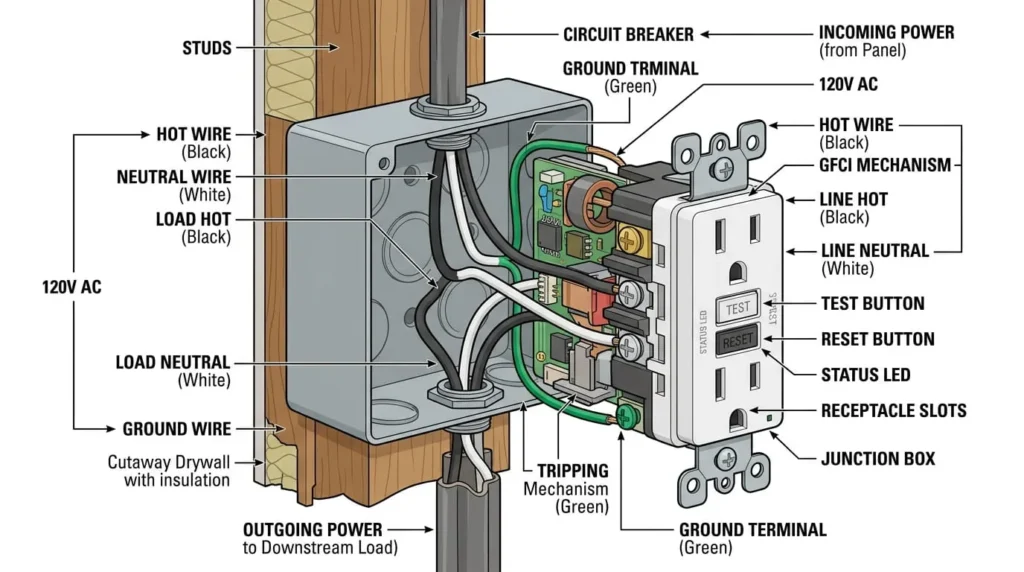
A ground fault inside an appliance, tool, or extension cord is sending current down an unintended path, which the GFCI correctly interprets as a hazard.
The circuit is overloaded, drawing more current than the outlet or wire is rated for, which can trip the breaker before or alongside the GFCI.
Line and load terminals were swapped during installation. A GFCI outlet has separate line and load connections, and reversing them can cause the outlet to appear to reset while it no longer protects anything downstream, or fail to reset entirely.
Electrical noise from certain LED dimmers, variable speed motors, or long circuit runs can occasionally cause a self-testing GFCI to nuisance trip, particularly on outlets manufactured after 2015 with automatic monitoring.
Corroded or loose wire connections inside the box, often from age, vibration, or a poor original installation, create resistance that the GFCI can misread as a fault.
When the Reset Button Won’t Click, What That Actually Means
There is an important difference between a Reset button that clicks but restores no power, and one that will not engage or click at all.
If the button clicks normally but nothing happens, the GFCI’s internal switch is closing correctly, so the problem is upstream of the outlet. That usually means no power is reaching the box at all, which points to a tripped breaker, a loose wire nut in the box, or a break somewhere earlier in the circuit.
If the button will not click, feels stuck, or pops back out immediately, the mechanism itself has likely failed. This is common in older outlets or units that have taken on moisture, and it is not something you can repair by adjusting or forcing the button. The outlet needs to be replaced.
Either way, do not keep forcing a stuck button. Repeated forcing can damage the internal contacts further and, in a wet or damaged unit, creates a small shock risk.
How to Troubleshoot a GFCI Outlet Not Working
Work through these steps in order. Each one rules out a simpler cause before you move to something that requires opening the outlet or calling for help.
- Unplug everything connected to the outlet. A faulty lamp, tool, or appliance can be the actual source of the ground fault, not the outlet itself.
- Press Reset firmly. Listen and feel for a distinct click. If power returns and stays on, plug your device back in and watch for a repeat trip.
- Check the breaker panel. Look for any breaker sitting slightly between on and off. Switch it fully off, then firmly back on.
- Test nearby and downstream outlets. If several outlets in the room or elsewhere in the house are also dead, an upstream GFCI or a shared breaker is the likely cause, not this individual outlet.
- Look and smell for damage. Discoloration, a burning smell, warmth around the faceplate, or visible moisture means you should stop testing and shut off the breaker instead.
- Use a plug-in outlet tester if you have one. A basic three-light tester confirms whether the outlet is wired correctly and receiving power, which helps narrow down whether the fault is in the device or upstream in the wiring.
If the outlet still will not reset, still shows no power, or trips again immediately after a reset, the issue is inside the wiring or the outlet itself and is not something to keep testing by trial and error.

GFCI Outlet or Circuit Breaker, How to Tell Which One Tripped
Some homes protect wet-area circuits with a GFCI breaker at the panel instead of, or in addition to, GFCI outlets. If you have both, figuring out which one actually tripped matters, because resetting the wrong one accomplishes nothing.
Start at the panel. A GFCI breaker that has tripped usually sits in a middle position between on and off, and it needs to be pushed fully off before it can be switched back on. If the breaker looks normal and is fully in the on position, the fault is more likely at the outlet itself.
If neither resets and stays on, or the breaker trips again within a few seconds, that points to an active ground fault somewhere on the circuit rather than a one-time nuisance trip.
When It’s Safe to DIY and When to Call a Licensed Electrician
Pressing a reset button, checking a breaker, and unplugging devices are safe for almost anyone to try. Opening the outlet box, rewiring terminals, or working while the circuit is live is not, unless you have the training and the right testing equipment.

Call an electrician if the outlet will not reset after basic troubleshooting, if it trips again immediately once devices are unplugged, if you see burn marks or smell anything electrical, or if the problem affects multiple rooms. The same goes for homes with wiring older than 20 to 25 years, since aging insulation and outdated grounding are common hidden contributors to GFCI failures that a visual check will not catch.
An electrician can measure actual voltage and current at the outlet, trace faults through the wall rather than guessing, and confirm the line and load terminals are wired correctly before installing a replacement.
Keeping a GFCI Outlet From Failing Again
GFCI outlets are not maintenance-free, and a few habits meaningfully extend how long they last.
Test every GFCI outlet in the house monthly using its own Test and Reset buttons, not just after something stops working. This confirms the safety function is still active, not only that the outlet passes power.
Use weather-resistant, or WR-rated, GFCI outlets in any outdoor, garage, or covered patio location, and always keep an in-use cover closed over outdoor receptacles even when nothing is plugged in.
Avoid daisy-chaining too many high-draw devices, like space heaters or power tools, off a single GFCI-protected circuit, since repeated overloading stresses both the outlet and the breaker.
Replace GFCI outlets proactively around the 15-year mark, or sooner in kitchens, bathrooms, and outdoor locations that see heavy use, rather than waiting for a hard failure.